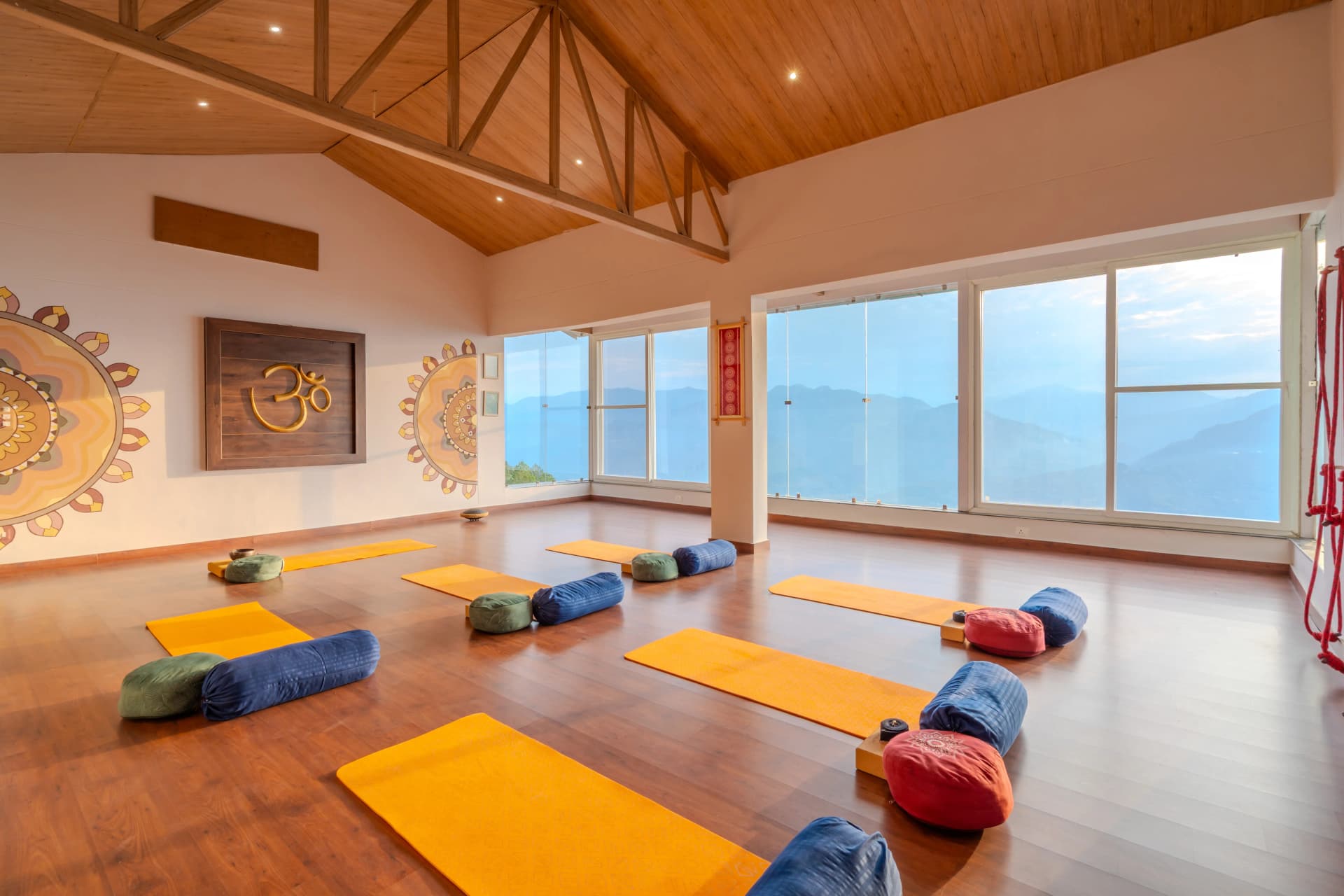
Yoga in the Himalayas vs a City Studio: Why Location Changes Everything
You have been practising yoga for years. Maybe months. Maybe you have a mat rolled out in the corner of your living room, a studio membership you use three times a week, a teacher you trust, a sequence your body knows by heart.
And yet, somewhere in the middle of a session — between the breath and the posture, between the traffic outside and the instructor's voice over the speaker — you have wondered what it would feel like to practice somewhere else entirely. Somewhere quieter. Somewhere the air is different. Somewhere the space between inhale and exhale doesn't have to compete with the sound of a city.
That question deserves a serious answer. Because location, it turns out, is not incidental to yoga. It is part of the practice itself.
What a City Studio Gives You — and What It Cannot
A good city studio offers structure, consistency, and community. A skilled teacher. A clean mat. A time slot that fits around your workday. These things are genuinely valuable, and for the rhythm of an ordinary week, they work.
But a city studio also asks you to do something extraordinarily demanding before your practice even begins: it asks you to leave the city behind without actually leaving it.
You commute to the studio. You park, or wait for an auto, or squeeze onto a metro. You arrive slightly breathless, slightly tense, slightly somewhere else in your head. You roll out your mat. And then, for sixty or ninety minutes, you try — genuinely try — to drop into stillness while the city presses against the walls from every direction.
It works, to a degree. The practice helps. The breath helps. A good teacher helps enormously.
But you are always, in some part of your nervous system, still in the city. Still available. Still within reach of the notification, the meeting, the obligation that didn't finish when you left the office.
The city is not just around you. After years of living in it, it is inside you — in the pace of your breath, the tension in your shoulders, the speed at which your mind moves from one thing to the next.
Why the Himalayas Change the Equation
Yoga did not emerge from a city studio. It emerged from mountains, forests, riverbanks, and the kind of silence that makes internal noise audible for the first time.
The yogis who shaped the practice over centuries were not working against their environment. They were working with it — using the altitude, the clean air, the natural rhythms of light and season, the quality of stillness that a Himalayan landscape carries, as instruments of the practice itself.
That relationship between place and practice is not merely historical. It is physiological.
At altitude, the body breathes differently — more slowly, more deliberately, recruiting lung capacity that months of shallow urban breathing have quietly neglected. The air at 1,800 metres carries none of the particulates, none of the noise, none of the electromagnetic density of a city environment. The nervous system, deprived of its usual barrage of stimulation, begins — sometimes within hours — to regulate itself differently.
Uttarakhand, the land where yoga's most ancient lineages took root, carries something that practitioners across centuries have described and that modern wellness science is only beginning to articulate: an environmental quality that makes stillness not something you have to work toward, but something the place simply offers.
Practicing at The Rudraksh Retreat: What Actually Happens
The Rudraksh Retreat sits at 1,800 metres in Selur village, Tehri Garhwal — above Tehri Lake, facing the snow-clad Gangotri range, surrounded by the forests of the Garhwal Himalayas. It is not a yoga school. It does not run a programme with scheduled classes and a graduation certificate.
What it offers is something rarer: the right environment for your practice to deepen on its own terms.
Here is what a morning yoga session at The Rudraksh actually looks like.
You wake before the alarm — something that rarely happens in the city. The light is already changing, pale and clear, over the eastern ridges. You step outside. The air has a temperature and a freshness that you feel in your chest before you've taken a conscious breath. There is birdsong — layered, unhurried, closer than you expected. Somewhere below, Tehri Lake holds the first pink of sunrise.
You unroll your mat. The Gangotri peaks are directly in your eyeline.
And then something quietly remarkable happens: you don't have to try very hard to be present. The place has already done most of that work for you. The breath comes more easily. The postures feel different — not better performed, but more inhabited. The space between thoughts, which in a city studio you have to actively carve out, arrives here on its own.
This is what practitioners who have done yoga in the Himalayas describe, consistently and across traditions: not that the practice changes, but that the relationship to the practice changes. The effort required to arrive at stillness is simply less. Which means the stillness available at the far end of that effort is deeper.
Six Specific Differences That Every Practitioner Notices
1. The breath is different at altitude
Pranayama in a Himalayan setting is a different experience from pranayama in a city studio. At 1,800 metres, the body naturally slows and deepens its breathing. The air carries no pollution, no particulates, no urban compression. Practices like nadi shodhana, kapalabhati, and bhramari find a spaciousness in the lungs that many practitioners have not felt since childhood. High altitude at retreats above 2,000 metres can genuinely support lung capacity training — and even at 1,800 metres, the difference from sea-level city air is immediate and tangible.
2. The nervous system arrives differently
In a city studio, the nervous system is still processing the commute, the news, the morning's emails, the half-finished conversation from last night. Savasana at the end of a studio class is genuinely restful — but it is rest layered on top of activation. At a Himalayan retreat, the activation itself begins to dissolve within the first day. By the second morning, the nervous system is functioning from a quieter baseline. The practice begins from a place of comparative stillness rather than trying to reach it.
3. The relationship with time changes
City yoga has a start time and an end time. You are in your posture, but you are also aware of what comes after it. At a retreat in the mountains, time organises itself around the light, the meals, the practice, and the movement of clouds over the peaks. There is no after the session to rush toward. This seemingly simple change — the removal of what comes next — alters the quality of attention available during the practice in ways that are difficult to fully articulate and impossible to replicate in a studio.
4. Meditation finally has room
Most city practitioners struggle with meditation more than they struggle with asana. The body can be stilled; the mind, full of city noise, resists. In the Himalayas, the external environment and the internal environment are less at odds with each other. Silence outside makes silence inside more accessible. Many practitioners who have found meditation frustrating or inaccessible in a studio context find that it opens naturally within a day or two in a mountain setting — not because they have suddenly become more disciplined, but because the gap between where they are and where meditation begins is simply shorter.
5. Sleep transforms the practice
Yoga is not only what happens on the mat. It is the state of the body and nervous system that the mat receives each morning. At The Rudraksh, sleep at altitude — in genuine quiet, in cool mountain air, with no artificial light and no ambient urban sound — is categorically different from city sleep. Practitioners consistently report waking earlier, feeling more rested, and arriving at their morning practice with a quality of alertness and ease that weeks of city sleeping cannot produce.
6. Nature becomes part of the practice itself
This may be the subtlest and most significant difference. In a city studio, nature is absent. The practice is contained — in a room, under controlled lighting, on a man-made surface. In the Himalayas, the practice is porous. The mountain is present. The forest is present. The quality of the air, the light on the peaks, the sound of water moving through the valley below — these are not distractions from the practice. For most practitioners who experience it, they become the practice. The boundary between what is yoga and what is just being here dissolves in a way that no studio has ever managed to replicate.
For Every Kind of Practitioner
If you are an experienced practitioner who has built a solid home or studio practice, a stay at The Rudraksh offers something you cannot manufacture through more practice alone: an environment that meets your existing depth and takes it further without forcing anything.
If you are a beginner or returning practitioner , the Himalayan setting removes the self-consciousness and striving that often makes early practice feel effortful. When the environment is already providing much of what the practice seeks, the practice becomes permission to receive rather than obligation to perform.
If you are a facilitator or yoga teacher looking for a venue to host your own retreat, The Rudraksh's 11-room intimacy, pure vegetarian kitchen, and natural setting in Tehri Garhwal create the conditions for the kind of transformative group experience that your participants will carry home and return for.
The Ancient Answer to a Modern Question
Uttarakhand has been called the Land of Yogis for centuries. The Garhwal Himalayas, where The Rudraksh sits, are part of the landscape that shaped yoga's deepest traditions — the same mountain range where sages practised, where the Ganges originates, where the Gangotri peaks rise above the Tehri valley in a silence that is not empty but deeply full.
When you practice yoga in the Himalayas — even for three days, even without a formal programme, even simply by unrolling your mat each morning on a terrace above Tehri Lake with the Gangotri range in front of you — you are not leaving your practice behind. You are bringing it somewhere it always wanted to go.
The city studio gave you the practice.
The mountains show you what the practice is for.
Begin Your Himalayan Practice at The Rudraksh
The Rudraksh Retreat in Tehri Garhwal, Uttarakhand, welcomes individual practitioners, wellness travellers, and retreat facilitators seeking the ideal environment for yoga and mindful living in the Himalayas.
With 11 rooms, a farm-to-table vegetarian kitchen, alcohol-free atmosphere, and one of the most quietly spectacular settings in Garhwal, it offers what no city studio can: a place where your practice has room to breathe.
Plan your stay at The Rudraksh →
The Rudraksh – A Himalayan Retreat is located in Selur village, Tehri Garhwal, Uttarakhand, at 1,800 metres above sea level — approximately 3.5 hours from Rishikesh and 3 hours from Mussoorie.